On a standard right-to-left page, start at the upper right and follow the panel groups and the speech bubbles, not a strict reversed Z. If your edition reads left to right, follow that direction. When a page offers two possible routes, pick the one where the grouping and the dialogue make sense. On your next hard page, number the panels and see whether the action and the conversation come in a sensible order.
Which direction do you read manga panels?
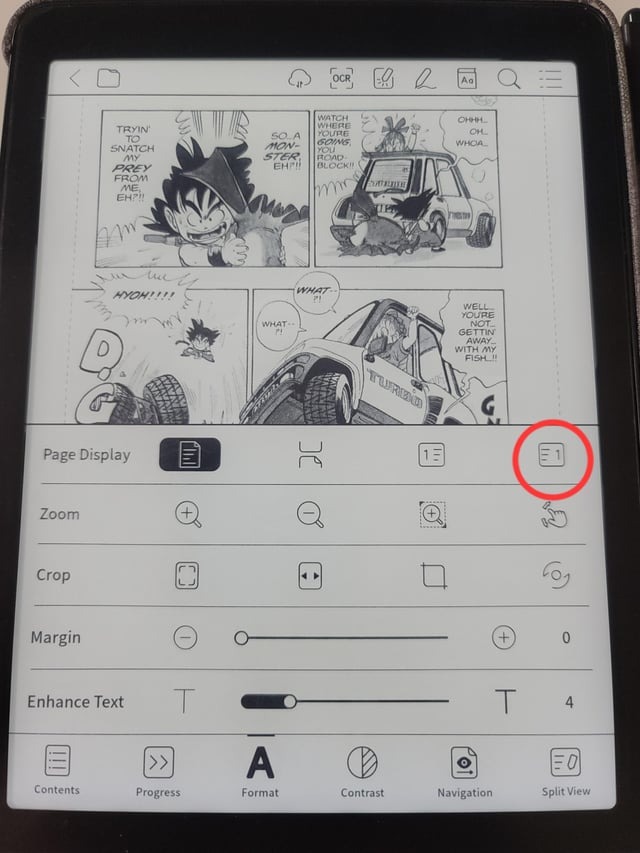
In a standard right-to-left manga edition, start with the panel in the upper right and follow the panel groups toward the left and down the page. When the book lies open to two facing pages, read the right-hand page first.
VIZ Media describes right-to-left reading as the usual convention in Japanese manga. Many English translations keep that page direction. Find out which direction your edition uses before you pick a starting panel.
A reader switching from the One Piece anime to its manga wrote on r/OnePiece: “So I just started reading the manga instead of the anime, and I keep getting confused on what order I’m supposed to read panels. Any help would be greatly appreciated!” (r/OnePiece discussion)
On a regular page with four equal panels in two rows, the order is easy to see:
- 1: Upper right.
- 2: Upper left.
- 3: Lower right.
- 4: Lower left.
A reversed Z connecting those four panels works as a memory aid for a simple grid. Uneven panels can form groups that pull your eye down a column before it crosses the page.
How do you follow Uneven manga panels and gutters?
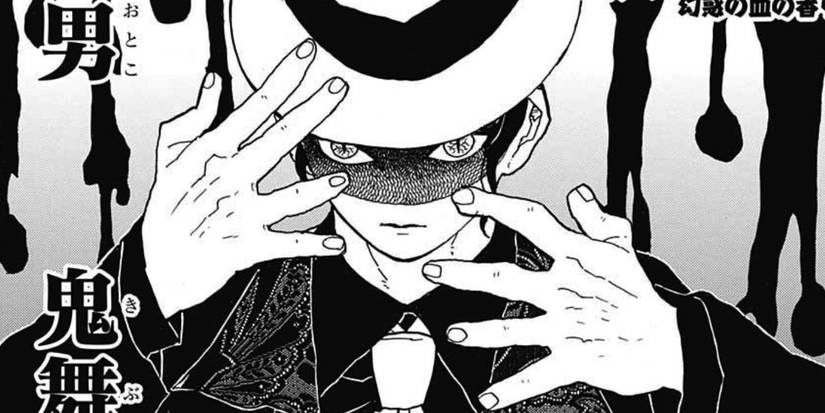
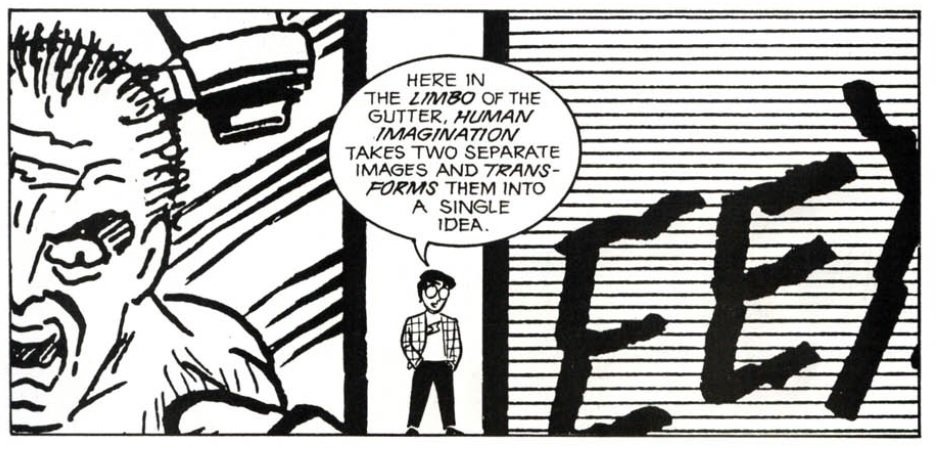
The white space between manga panels is called a gutter. Its shape splits a set of panels into a column or a tier, so you can see which panels form the next group.
Here's a made-up three-panel layout. A sits at the upper right. B sits right beneath it. C is a tall panel to their left. One continuous vertical gutter runs from the top of C to the bottom and separates C from the right-hand stack. You read A, then B, then C.
Now change the divisions and keep the labels. A stays at the upper right and C stays on the left. C is shorter, though, and ends above B's top edge. B moves farther down, and a broad horizontal white band runs under A and C. Because C now sits next to A and B is cut off below, you read A, then C, then B.
Same three panels, different gaps, different order.
In a 2013 panel-navigation study by Neil Cohn, 145 volunteers numbered 12 layouts of empty panels. Blocking and separation pushed readers away from the familiar Western Z-shaped route more than overlap or staggering did. The study used a Western reading baseline, so its findings show a structural influence on the route.
MediBang Paint's frame-splitting tutorial shows how adjusting the divisions between panels makes a creator's route easier to see.
What order do you read manga speech bubbles?
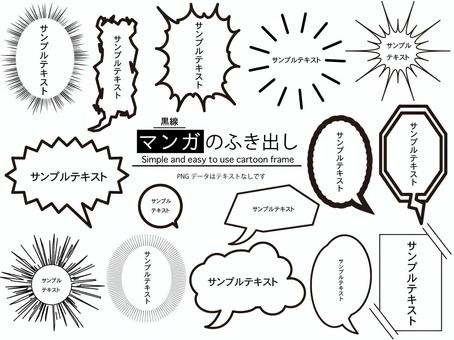
Follow the speech bubbles in the order of the conversation. On a right-to-left page, bubbles toward the upper right come before those farther left in the same clearly ordered group. The English words inside each bubble still read in normal English order.
A reader of an English translation of Berserk asked on r/NoStupidQuestions: “During translation is that changed for western audiences? Should I be reading left to right inside each text box while overall moving right to left?” (r/NoStupidQuestions discussion)
In one panel, “Did you hear that?” sits in an upper-right bubble and “Behind us.” in a bubble to its left. The conversation moves from the first bubble to the second.
| Reading level | What sets the order |
|---|---|
| Facing pages | The edition's page direction |
| Panels | Frame positions and visual groups |
| Speech bubbles | Dialogue placement and exchange |
| English words | Normal left-to-right English text |
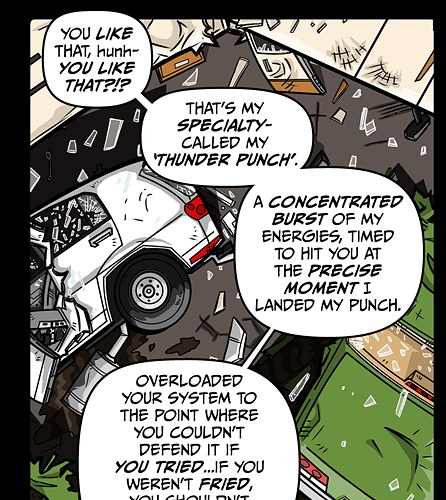
A central bubble sometimes overlaps a panel border or sits between two neighboring groups. The dialogue around it and its position in the scene place it in the exchange, especially when two possible paths pass near the same bubble. Its tail points toward the person speaking.
What If two manga reading paths seem possible?
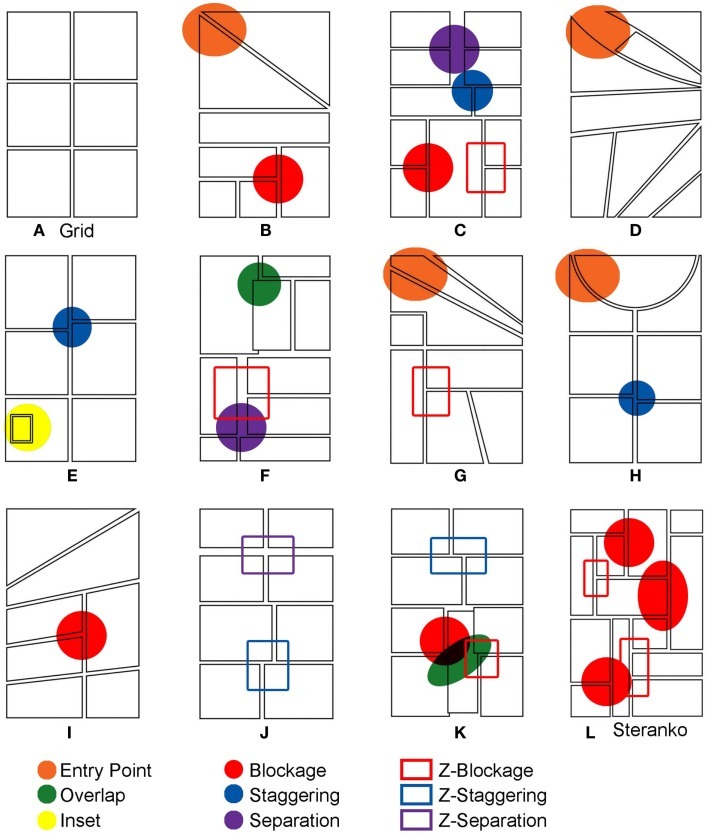
When a page offers two possible routes, look at the panel groups first, then at the dialogue. A continuous gutter can favor reading down one column, even when the upper panels invite a quick move across the page.
In a four-panel scene, A is at the upper right and asks, “Where's the key?” B sits directly below A, with a bubble near its right edge answering, “In the drawer.” To their left, C is one tall panel running alongside both A and B and showing a hand opening the drawer. D sits below C and reveals the key. The horizontal divider between A and B ends at the long vertical gutter beside C, so there's no matching upper row across the left-hand side.
Route 1 goes across the top: A → C → B → D. Route 2 follows the column: A → B → C → D.
| Clue | Route 1: A → C → B → D | Route 2: A → B → C → D |
|---|---|---|
| Interrupted upper row | Enters the tall left panel after A, then returns right to B | Completes the A-and-B stack before crossing the long gutter |
| Dialogue placement | Reaches the drawer before the reply | Reads the answer below A before the action |
| Scene progression | Question, search, reply, discovery | Question, reply, search, discovery |
Here the combined cues favor Route 2.
A 2023 eye-tracking study by Clare Kirtley and colleagues found that the structure of panel outlines was an important influence on navigation. Text position also affected eye movements in some ambiguous layouts.
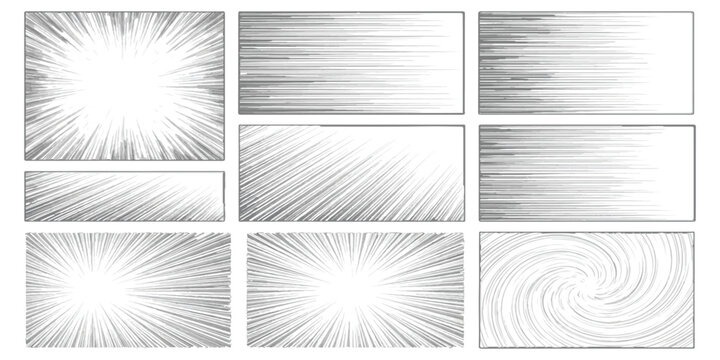
A large sound effect or a dramatic motion line can pull your eye to the left side of a scene.
Some experimental layouts stay ambiguous even after you weigh every clue.
What about four-panel manga, double-page spreads, and left-to-right editions?
A yonkoma arranges four panels in a vertical strip, read from top to bottom. A double-page spread joins facing pages into one layout, with its own groups across the larger image. Left-to-right adaptations and Western manga-style works follow their own direction.
How can you check your reading order on a confusing page?
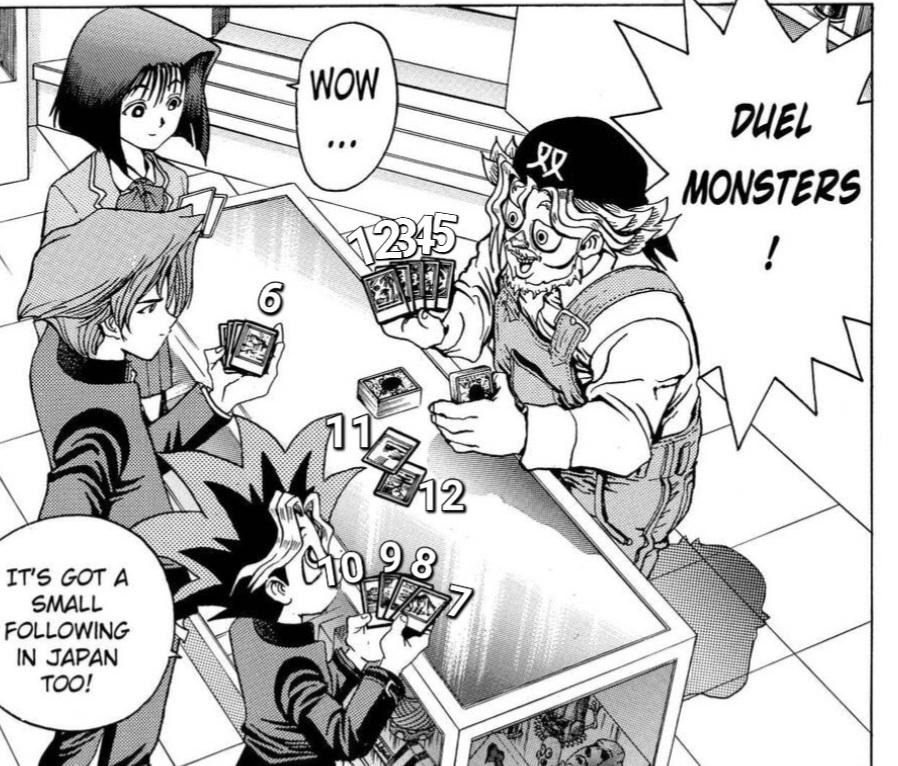
Try numbering the panels of a five-panel page before you look at the answer. Two small panels form a column on the right: A shows a sudden “CLINK,” and B shows a character turning toward the noise. A tall panel C sits to their left, behind a continuous vertical gutter. D and E form a lower row, right to left.
In B, a small “What was that?” bubble sits close to the border beside C. Panel C reveals a dropped object. D asks, “Who's there?” E answers, “It's me.” Panel C is tall, so it pulls your eye left right after A. But B's bubble carries the character's reaction, and that comes before the reveal.
Which route fits the divisions and the conversation?
- Route 1: A → B → C → D → E.
- Route 2: A → C → B → D → E.
| Step | Panel | Event |
|---|---|---|
| 1 | A, upper right | A sudden “CLINK” sounds |
| 2 | B, below A | The character turns and asks, “What was that?” |
| 3 | C, tall left panel | The dropped object is revealed |
| 4 | D, lower right | The character asks, “Who's there?” |
| 5 | E, lower left | Another character replies, “It's me.” |
Route 1 is the intended one for this page. The continuous gutter puts A and B in the first group, and the character turns before the object is revealed. Route 2 would cross that boundary after the sound and show the object before the reaction.
How can creators tell whether their manga page reads clearly?
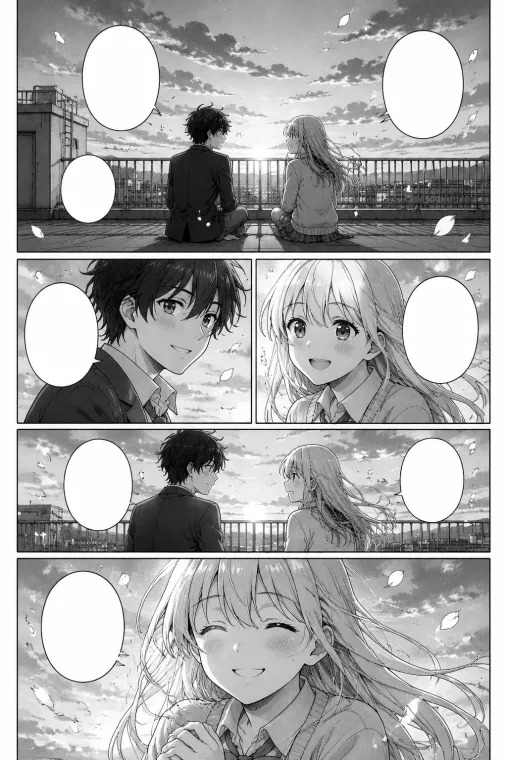
As the creator, you know the sequence before you draw a panel. A new reader has to work it out from the page.
Give an unnumbered draft to somebody who has never seen the storyboard. Ask them to mark the order of panels and speech bubbles they follow naturally. Don't explain your route first.
If you intend 1 → 2 → 3 → 4 → 5 but the reader marks 1 → 3 → 2 → 4 → 5, look at the second choice. The gutter can separate the wrong pair of panels, or an early speech bubble can pull the eye across the page. Fix those and the flow gets clearer.